Interview practice for working with AI
Companies now test how developers work with AI. In a coding round they give you an AI assistant and look at what you ask it, what you accept and what you change before you submit. They ask how language models work and where they fail, and they ask you to explain each decision.
Building with AI lets you practise each of these rounds with an AI interviewer. Every round gets its own report.
- AI Knowledge Q&A
- AI Feature Build
- AI Workflow Design
- Spoken answers transcribed
- 1 or 2 credits per round
The three Building with AI rounds
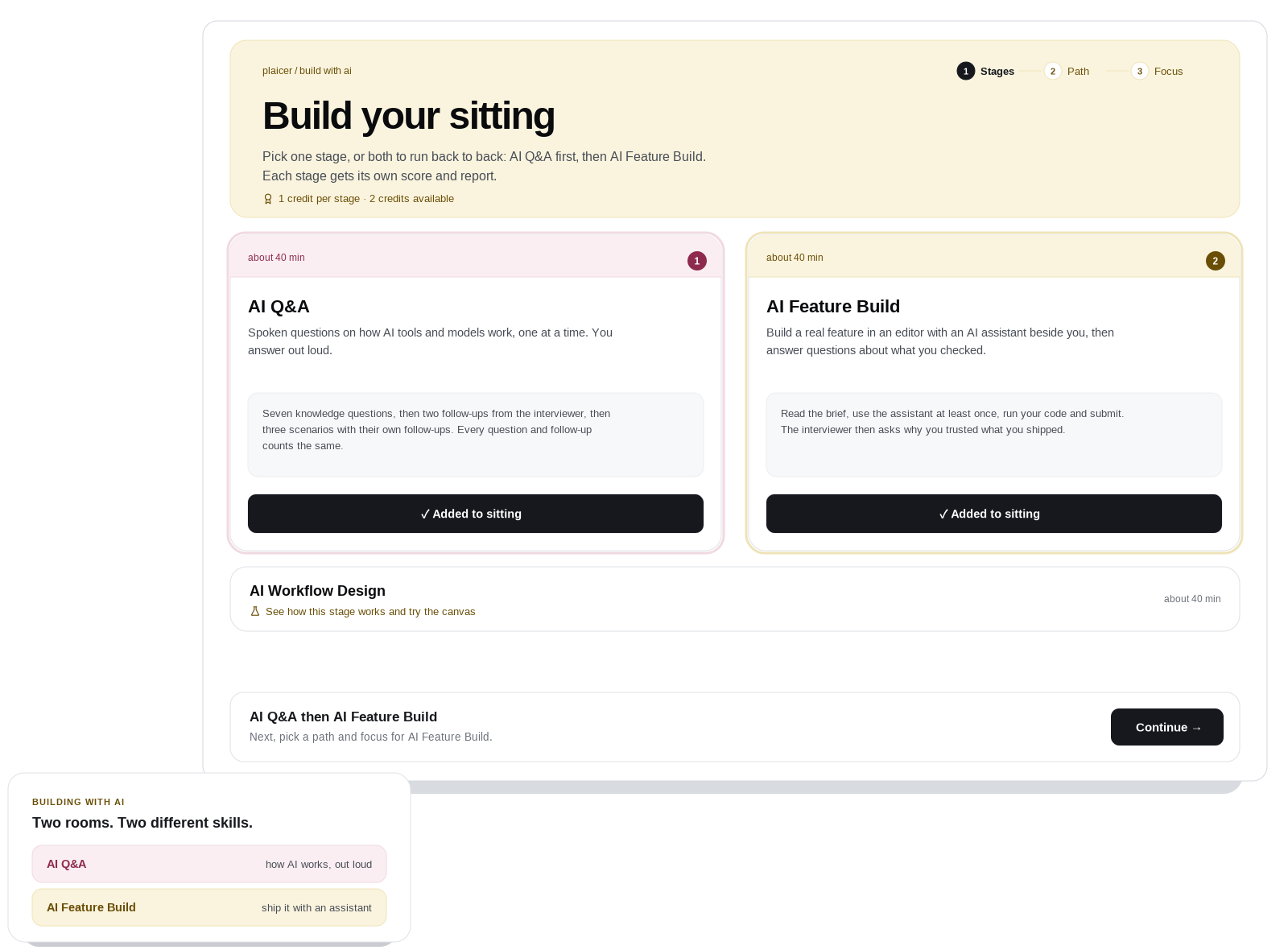
AI Knowledge Q&A tests what you understand about AI. AI Feature Build tests how you build with an AI assistant. AI Workflow Design tests how you design a process that uses AI. Choose one round or several, and each round gets its own report.
Choosing your rounds and the credit cost
Choose the rounds you want to practise and the credit total updates before you start. AI Knowledge Q&A costs 1 credit. AI Feature Build and AI Workflow Design cost 2 credits each.
If you include AI Feature Build, you also choose a path and the focus areas the feature is drawn from. Rounds you complete keep their reports if you stop early.
- Add one or more rounds.
- For AI Feature Build, choose a path and focus areas.
- Check the credit total and start.
- Allow microphone access for the spoken rounds.
AI Knowledge Q&A
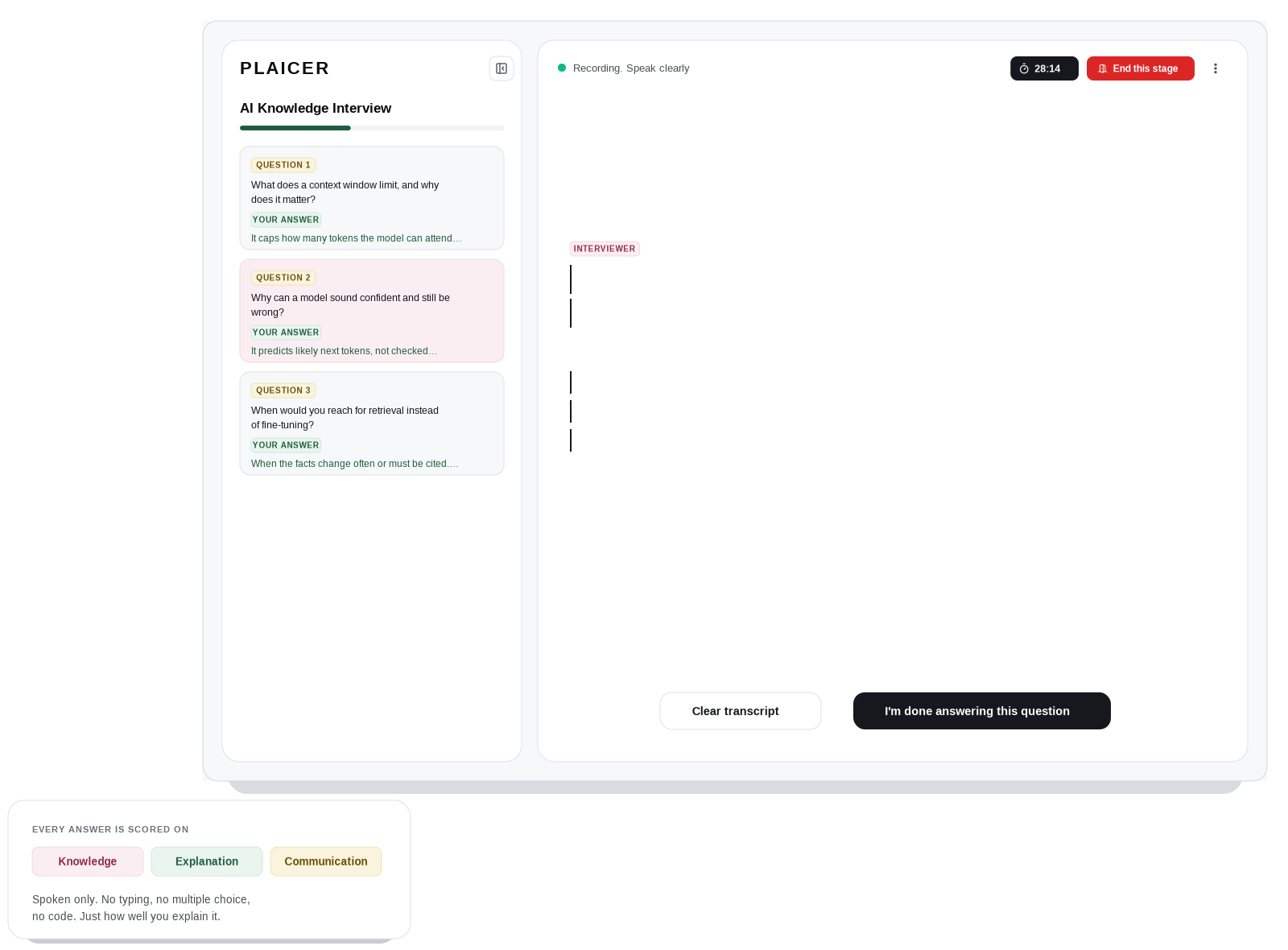
Interviewers now ask how language models and AI tools work and where they fail. In this round you answer seven knowledge questions by voice and two follow-ups from the interviewer on what you said. Then you work through three scenarios that describe a situation and ask what you would do, each with its own follow-up.
There is no typing, multiple choice or code. Every question and follow-up counts the same, and the round lasts up to 40 minutes. The report scores knowledge accuracy, explanation quality and communication.
- Allow microphone access, then the first question appears.
- Answer seven knowledge questions one at a time.
- Answer two follow-ups based on what you said.
- Work through three scenarios and their follow-ups.
AI Feature Build
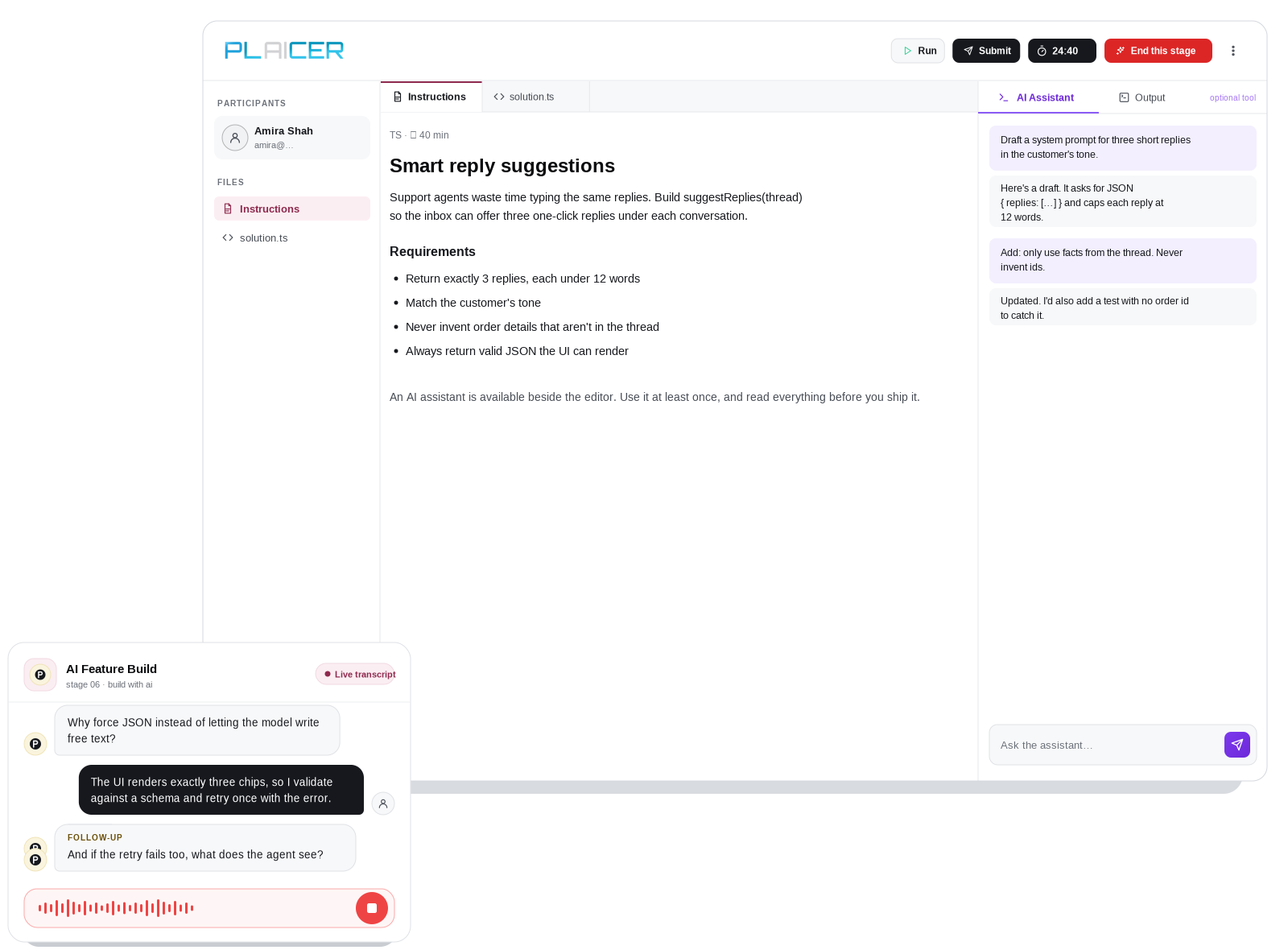
Some coding interviews give you an AI assistant and assess how you use it. Here you get a short feature brief, starter code, a test suite and an AI assistant you can prompt. Every decision about what goes into the final code is yours.
You need at least one exchange with the assistant before you can submit, because reviewing its code is part of what is assessed. The number of prompts you send is not scored. After you submit, the interviewer asks why you accepted, changed or rejected the assistant's suggestions.
- Read the feature brief, the starter code and the tests.
- Prompt the assistant for what you need.
- Check its code, fix what is wrong and run the tests.
- Submit the version you are ready to explain.
- Answer the interviewer's questions about your decisions.
AI Workflow Design
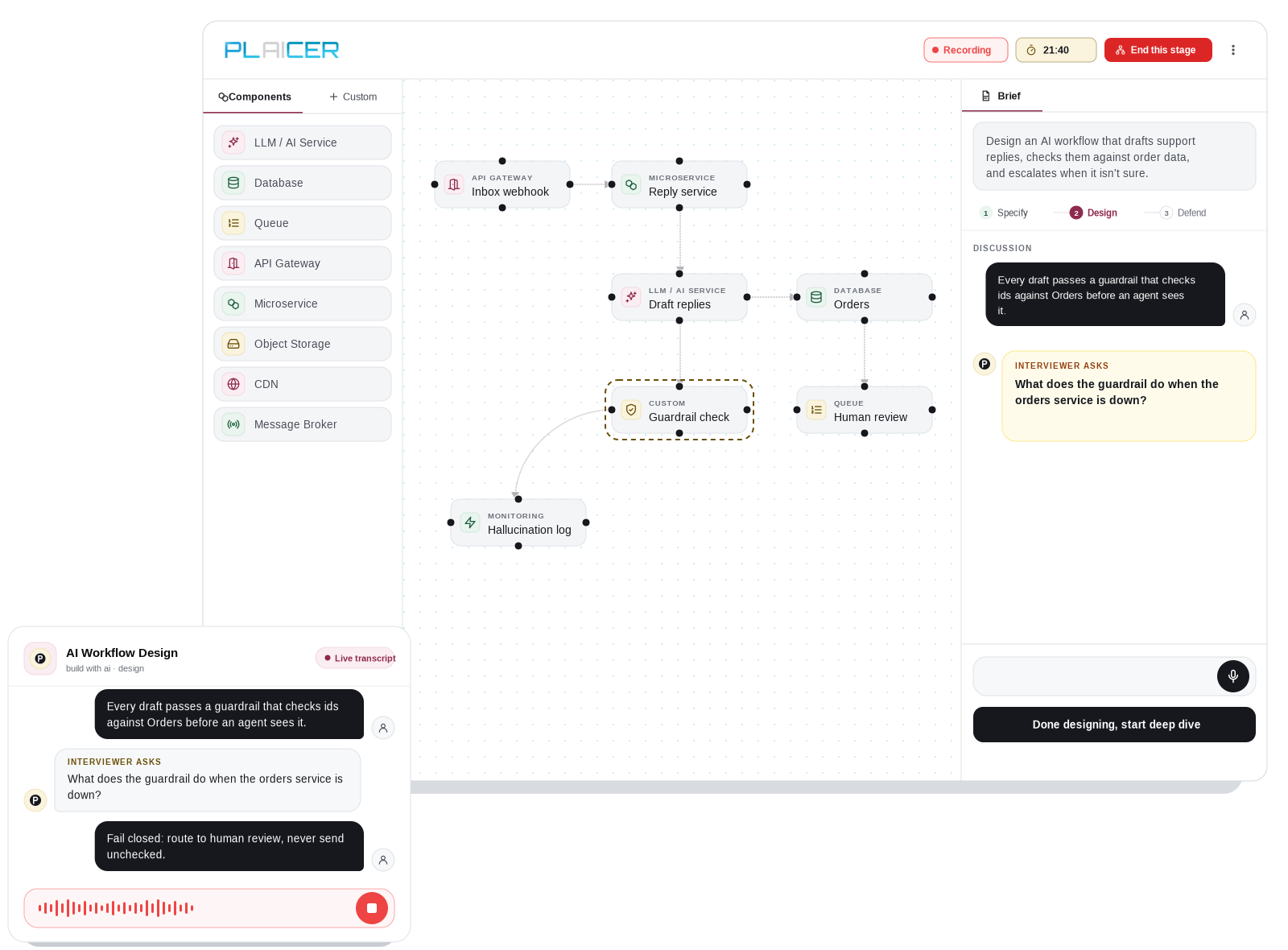
You get a business brief and a canvas. Ask the interviewer for the facts you need and what the brief means, then design the workflow step by step and explain it as you go. You decide which steps AI handles, which stay with people and how the process is checked.
When the design is finished, the interviewer asks what happens when a step fails, how you would roll it out alongside the existing process and where the risks are. You need a computer for this round, because you design on a canvas and answer by voice.
- Read the brief and ask the interviewer your questions.
- Place the workflow steps on the canvas and connect them.
- Explain the design to the interviewer as you build it.
- Answer questions on reliability, safety and rollout.
How each round is scored
Every dimension and every overall score uses one of the four words used across Plaicer, with written feedback on what to work on next. Building with AI keeps its own history and does not change your Technical Interview Practice progress score.
Developing
There is little evidence of the skill yet. The report names the dimension that cost you most.
Emerging
The skill shows but is incomplete, and the report shows which parts to close first.
Competent
The skill does the job with gaps you can name, and the report shows what separates it from Strong.
Strong
Answers are specific, correct and well reasoned against the published criteria.
Your speech is transcribed by your browser's built-in speech service. Plaicer stores the text transcript and does not store audio.
Other interview practice on Plaicer
Each product prepares you for a different part of the hiring process and keeps its own history on your dashboard.
Questions about Building with AI
Answers to common questions. For anything else, email the Plaicer team.
Email a questionWhat is Building with AI?
Building with AI is the part of Plaicer for interview rounds about AI. It has three rounds. AI Knowledge Q&A is a spoken interview on how AI tools and models work. AI Feature Build has you build a feature with an AI assistant and then explain what you submitted. AI Workflow Design has you design an AI-assisted workflow for a business brief on a canvas and explain it to the interviewer. Each round gets its own report.
How is it different from Technical Interview Practice?
Technical Interview Practice has five stages on general engineering. They are Interview Q&A, Live Coding, Project Deep Dive, System Design and Code Review. Building with AI tests how well you understand AI and how you work with it. It has its own history and does not count toward your Technical Interview Practice progress score.
How does AI Knowledge Q&A work?
You answer each question by voice, one at a time. There are seven knowledge questions, then two follow-ups from the interviewer on what you said, then three scenarios with their own follow-ups. Every question and follow-up counts the same. There is no typing, multiple choice or code, and the round lasts up to 40 minutes.
What happens in AI Feature Build?
You get a short feature brief, starter code, a test suite and an AI assistant you can prompt. You build the feature in about 30 minutes, deciding what to ask the assistant for and checking its code before you submit. After you submit, the interviewer asks about the decisions you made.
Do I have to use the AI assistant?
In AI Feature Build, yes. You need at least one exchange with the assistant before you can submit, because reviewing its code is part of what is assessed. The score looks at how clearly you directed it and whether you checked its code before it reached your final version. The number of prompts you send is not scored.
What happens in AI Workflow Design?
You get a business brief and a canvas. You ask the interviewer for facts and what the brief means, design the workflow step by step while explaining it, then answer questions on reliability, safety and how you would roll it out. You need a computer, because you design on a canvas and answer by voice.
Can I practise more than one round at once?
Yes. Choose the rounds you want and you see the credit total before you start. Rounds you complete keep their reports if you stop early.
How am I scored?
AI Knowledge Q&A is scored on knowledge accuracy, explanation quality and communication. AI Feature Build is scored on correctness, checking the assistant's code, business judgement, code quality and how you directed the assistant. AI Workflow Design is scored on workflow design, clarifying the brief, reliability and safety reasoning, right-sized use of AI and communication. Every score uses one of four words, Developing, Emerging, Competent or Strong.
How much does it cost?
Building with AI uses the same credits as the rest of Plaicer. AI Knowledge Q&A costs 1 credit, and AI Feature Build and AI Workflow Design cost 2 credits each. If you practise with a cohort that funds these rounds, the cohort's credits are used first.
Is my voice recorded?
Your speech is transcribed by your browser's built-in speech service. Plaicer stores the text transcript and does not store audio. The questions and follow-ups you were asked are kept with the transcript. In AI Feature Build, your chat with the assistant and your code are kept so the report can refer to them.
Start a Building with AI round
Choose one round or several and check the credit total before you start. Each round you complete gets its own report.