Plaicer for new graduates
Many applications for developer roles start with a timed data structures and algorithms assessment, and the format depends on the company. Some send two problems in 45 minutes, and some leave out the easy opener or send four problems ordered easy to hard.
Plaicer runs four assessment formats and all five interview stages that follow them. Each format keeps its own score history, and each stage gets its own report, so you can see which part of the process to work on before you apply.
- Data Structures and Algorithms Screening Practice
- Project Deep Dive
- Live Coding
- Code Review
The four assessment formats
Each format keeps its own history and progress chart. Your first round in a format sets the baseline and later rounds are measured against it.
2-problem screen
45 min
Easy, Medium
One easy and one medium problem. The easy problem is meant to be cleared quickly, so the test is whether you leave enough time for the medium one.
2-problem extended screen
70 min
Medium, Medium
Two medium problems with no easy opener. Both carry equal weight and your pacing decides whether you finish.
4-problem sprint
70 min
Easy, Medium, Medium, Hard
Four problems, ordered easy, medium, medium, hard. Choosing what to attempt and what to leave is part of what the report gives feedback on.
4-problem full round
90 min
Easy, Medium, Medium, Hard
The same shape as the sprint with 90 minutes, so there is time to write a solution to the hard problem that scales.
The stages that follow the first screen
After the screening assessment, interviews test what you built and how you explain it. These stages are available on their own.
What happens on screen
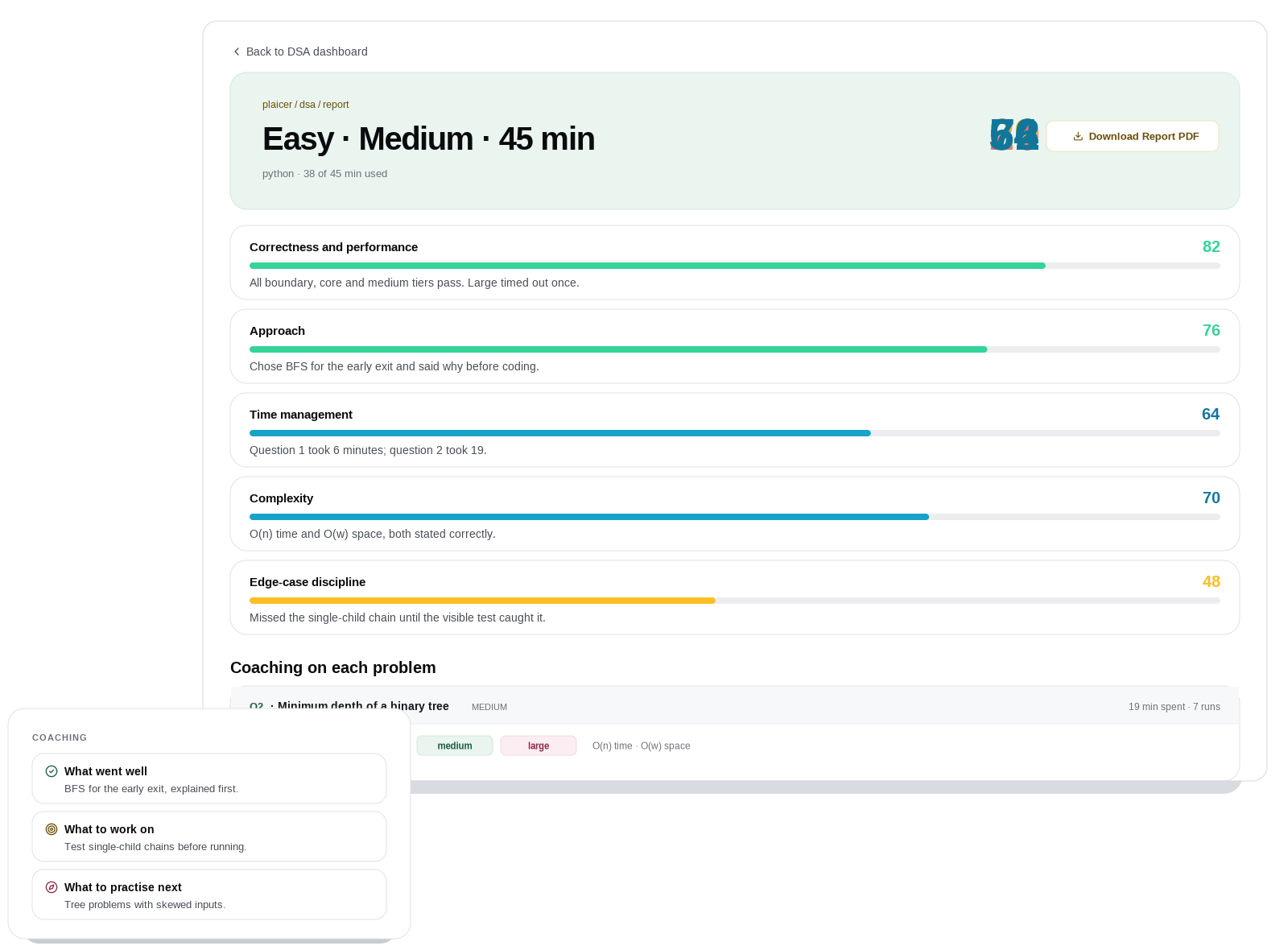
What the screening report shows for each problem
When the round ends you get one score, the share of tests you passed. Below it is written feedback on every problem, covering the idea behind your approach, whether it scaled, how the code reads and how you paced the round.
Hidden test results are shown group by group, so you can see whether you lost marks on edge cases, ordinary inputs or the largest inputs that test performance.
- See your overall pass rate across visible and hidden tests.
- Open each problem for its test groups and written feedback.
- Read the notes on approach, complexity, code quality and pacing.
- See the order in which you should have opened the problems.
How Project Deep Dive works
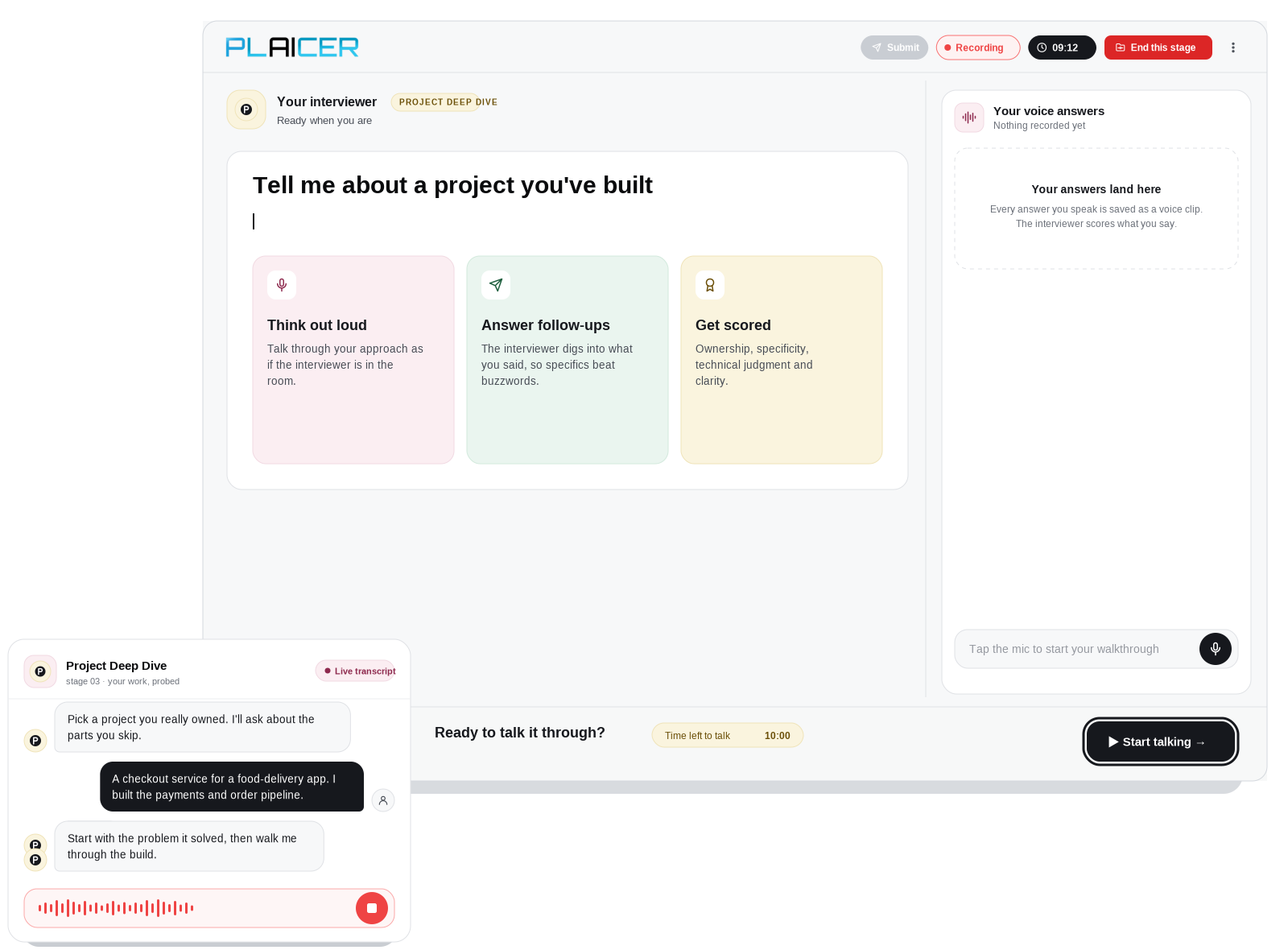
Interviewers often ask you to explain a project you built and then test how well you know it. Here you choose a project you built and explain what it does, how it is put together and why you made the decisions you made.
The interviewer then asks about your architecture, your trade-offs and what you would change now. Each claim you make can become a follow-up question.
- Introduce the project and the problem it solves.
- Explain the architecture and the main decisions.
- Answer follow-up questions on each decision.
- Explain what you would change and why.
How Live Coding works
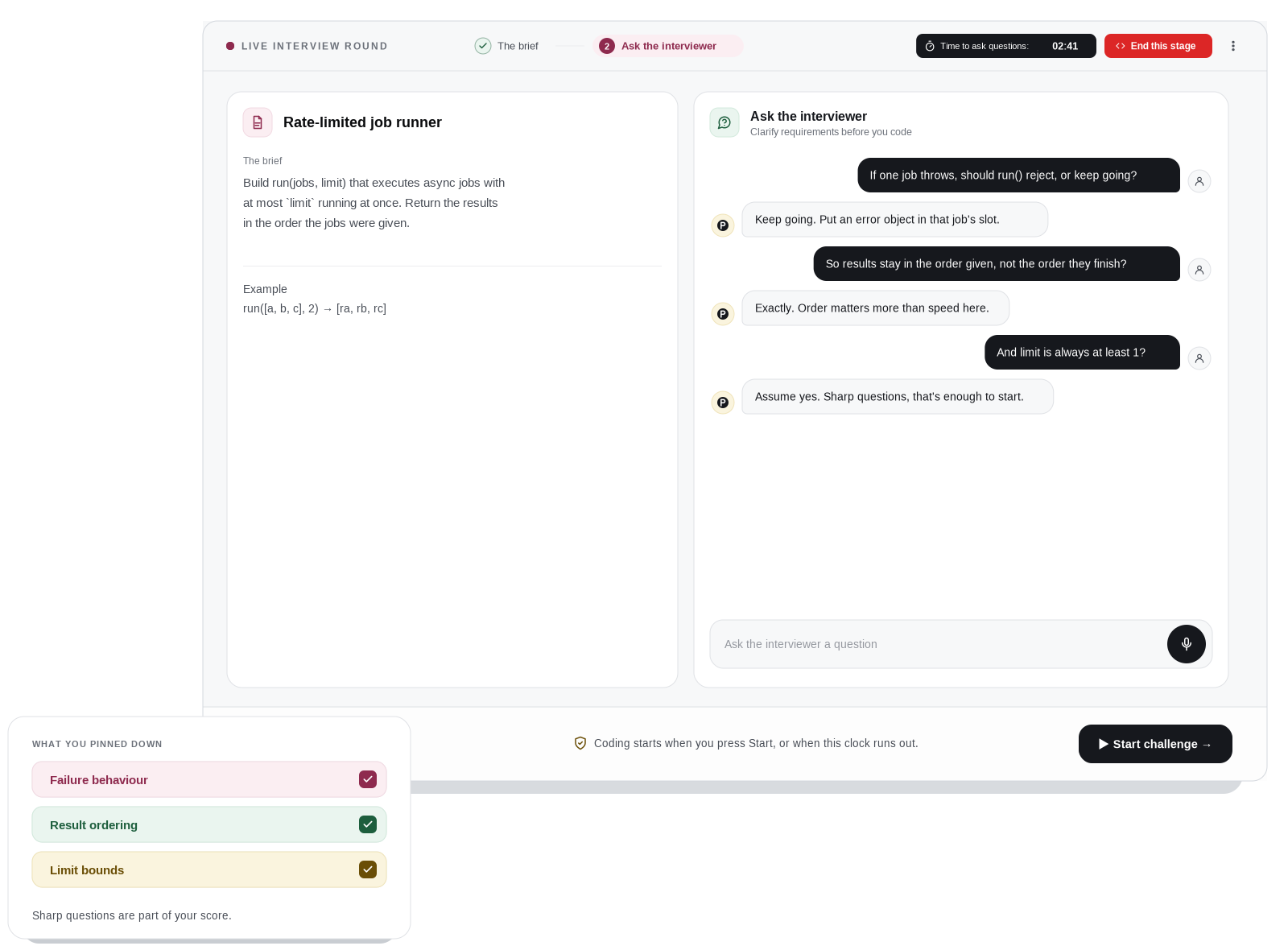
In a live coding interview you write or fix code while the interviewer watches and asks about your choices. Here you get unfinished or broken code and a real test suite, and you fix or build it while explaining your reasoning to the interviewer.
You can ask clarifying questions at any point. The interviewer scores your reasoning as well as the tests.
- Read the brief and the failing tests.
- Ask clarifying questions before you choose an approach.
- Write code against the test suite and explain your thinking as you go.
- Answer the interviewer's questions about your approach after you submit.
How screening rounds are run
The order you work in is reviewed
The round records when you opened each problem and how long you stayed. The report shows where your time went and which order would have worked better. This feedback is not part of your score.
Hidden tests run when you submit
Visible tests are there to work against while you code. Hidden tests run only when you submit, and their results stay hidden until the round ends.
No repeated problems
Each round leaves out every problem you saw in your last three rounds, so your score is based on problems you have not seen recently.
The clock does not stop
When time runs out, whatever you have written is collected and scored. There is no pause and no extra time.
Every problem is checked first
Each problem has a reference solution that has been run and confirmed to pass in your chosen language before the problem can be given to you.
Four languages
Write your solutions in Python, Java, C++ or JavaScript. You choose the language when you set up the round.
What the report shows for each stage
Each stage gets its own report. It gives an overall score, a score for each named dimension, the areas to work on, your strengths and what to practise next. If you practise more than one stage, a summary looks across the stages for gaps that keep coming up.
Skills scored in every stage
- Communication
- Question-asking
- Depth under probing
Other ways people use Plaicer
Each page describes the products that matter most for one kind of reader and the interview each product prepares for.
Questions about Plaicer for new graduates
Answers to common questions. For anything else, email the Plaicer team.
Email a questionWhich screening formats can I practise?
There are four. Two shorter screens have two problems each, at 45 and 70 minutes. Two longer rounds have four problems each, at 70 and 90 minutes, always ordered easy, medium, medium, hard.
What are hidden tests?
Each problem has visible test cases you can run as often as you like and a second set of hidden tests you do not see. The hidden tests run only when you submit, and their results stay hidden until the round finishes, which is why a solution that passes the examples can still fail.
Can I retake a round?
Yes. Each round leaves out every problem you saw in your last three rounds, so a retake gives you new problems.
Do my scores carry across the formats?
No. Each format keeps its own history and progress chart. Your first round in a format sets the baseline and later rounds in that format are measured against it.
Which project should I bring to Project Deep Dive?
A project you built and owned. You explain what it does, how it is put together and why you made the decisions you made, and the interviewer asks follow-up questions on each claim.
What happens when the timer runs out?
Whatever you have written is collected and scored, as in a real assessment. There is no pause and no extra time.
Start a screening round
Choose a format and a language, and the clock starts. The report covers every problem in the round.