Daily practice on Plaicer
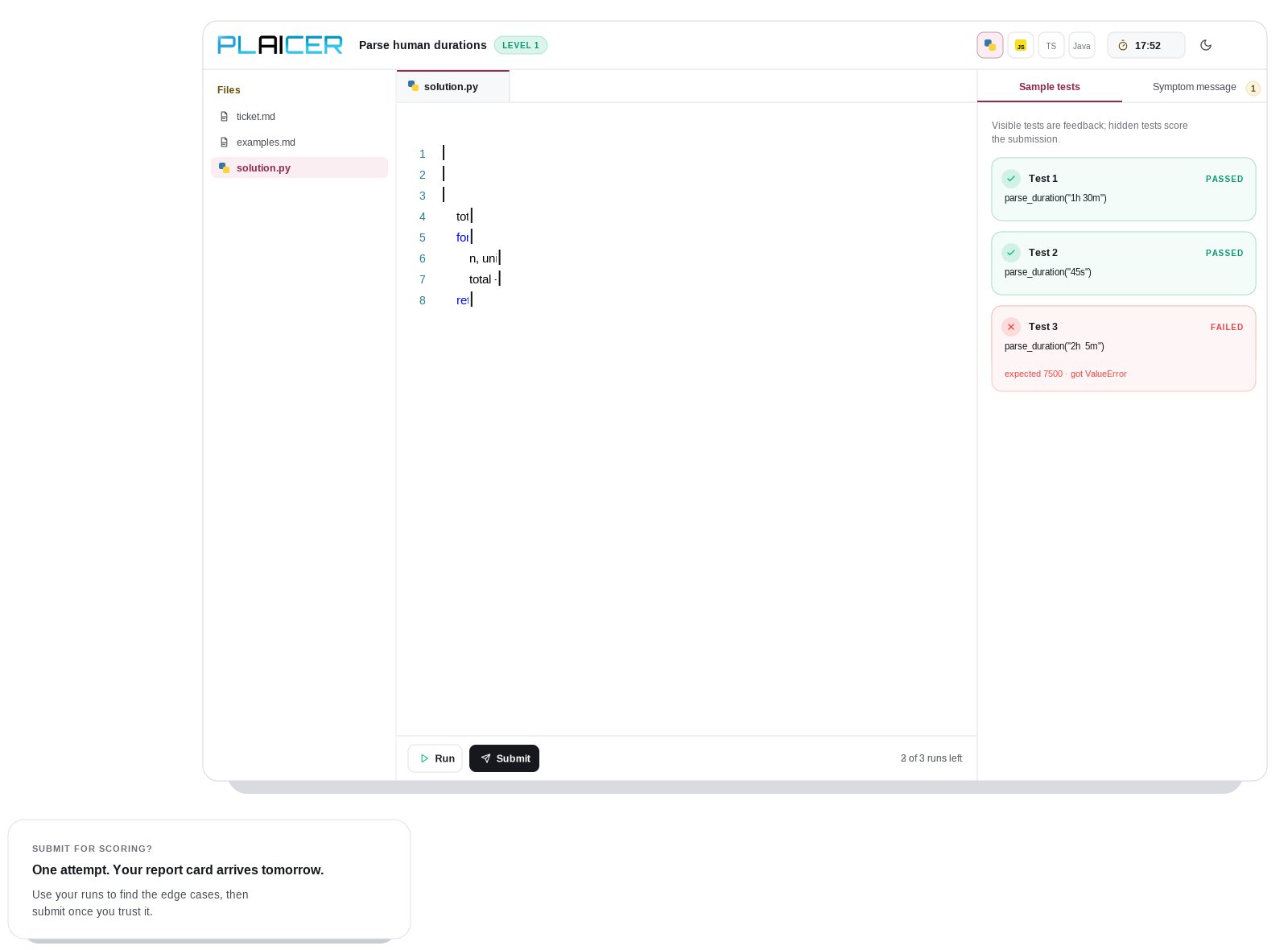
Interviews often judge code only by its result, from a short brief, with no help while you work. 30/30 Daily Practice gives you that setting once a day, with one production-framed task at the level you choose.
Opening the task counts as your attempt, you submit once, and the report card for your submission arrives the next day. The Training Ground cards hold the rest of the tasks, which you can open in Training mode or Challenger mode.
- 30/30 Daily Practice
- Python Backend Tasks
- Code Judgement Tasks
- Training Ground
What happens in 30/30 Daily Practice
How a day of 30/30 Daily Practice works
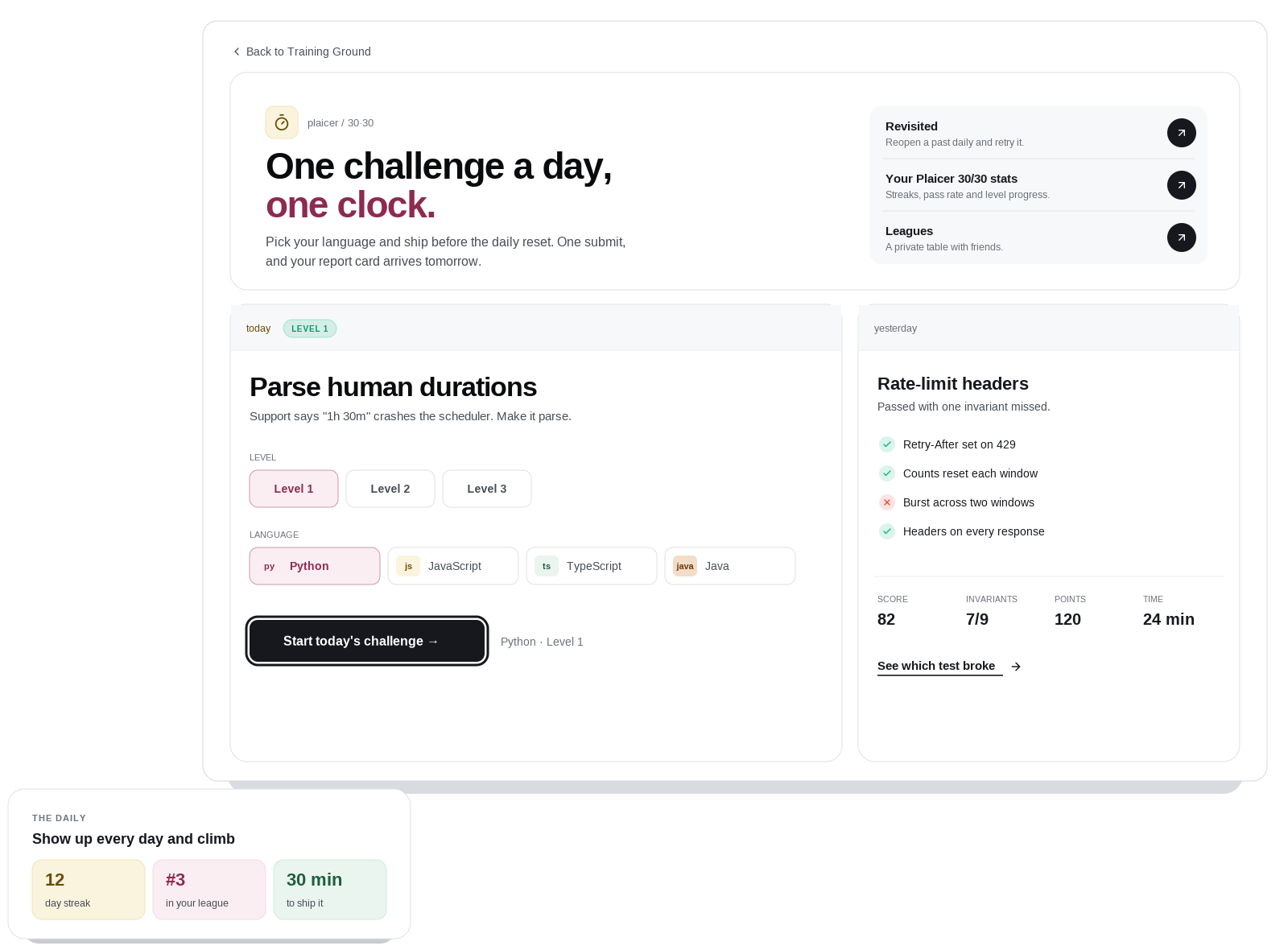
A new task opens each day at 03.00 Malta time and submissions close at 01.00 the next morning. Each task is set in a backend scenario such as checkout latency, rate limiters or ranking pipelines, and the brief is short.
Opening the task counts as your attempt. If you leave and come back, it does not open again, whether or not you submitted. Each task has its own time limit, shown as a timer while you work.
- Choose Python, JavaScript, TypeScript, Java or Go, where the task supports them.
- Use up to three runs, and each run reports how many sample tests passed.
- Submit for scoring once. You do not see a score when you submit.
- Read the report card the next day, with a feedback line for each behaviour checked.
Streaks and league tables
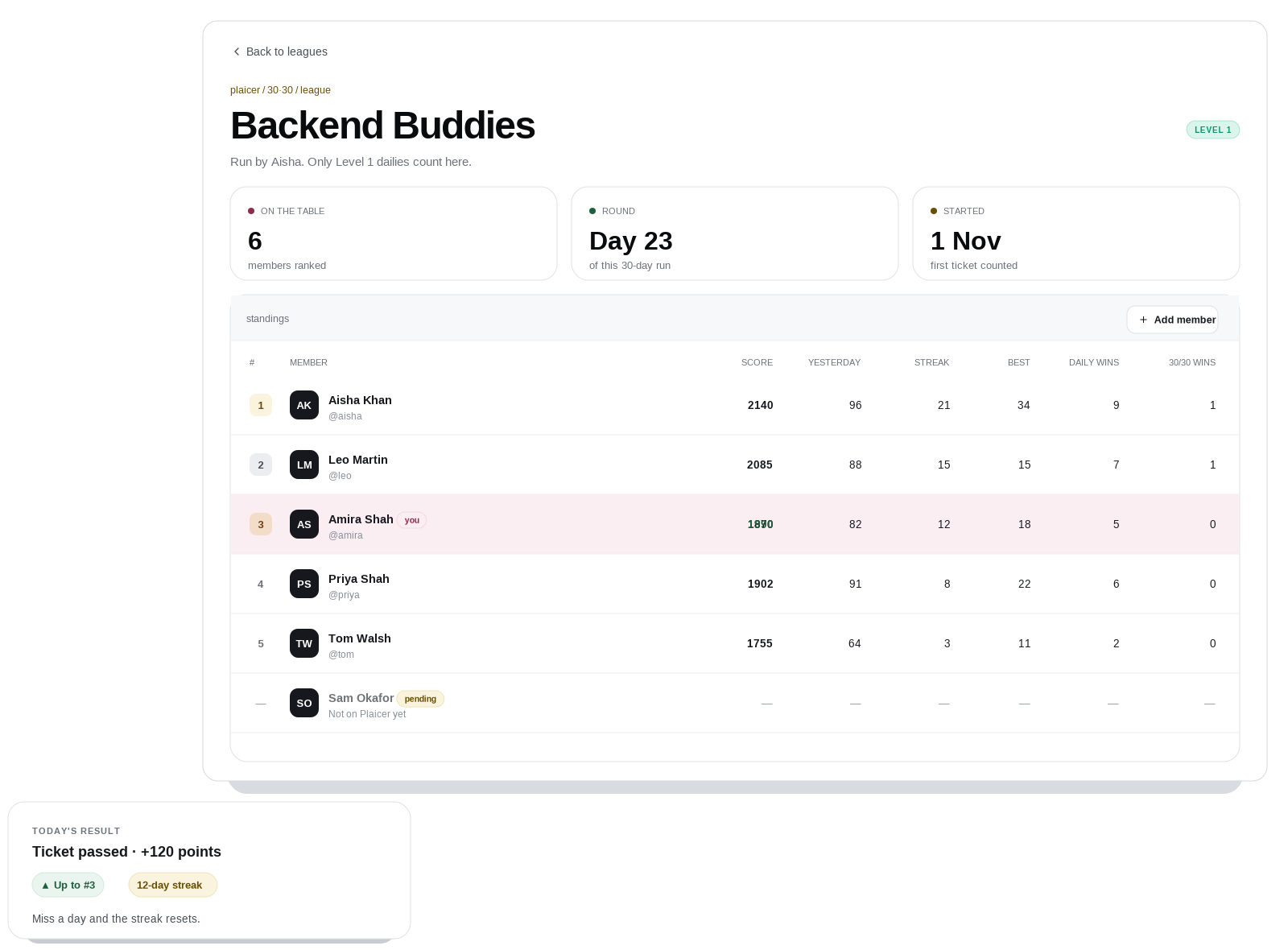
Your streak counts the consecutive days on which you submitted a daily task that passed at least one visible test. Missing a day ends it, and your best streak is kept.
Between 01.00 and 03.00 Malta time the page shows Between days while the league tables are settled, and no task can be started.
The other Training Ground cards
The later rounds of a technical interview often set a practical task. The Training Ground cards let you practise these tasks without the interviewer and without the microphone.
Production Skills Exercises are guided practice applying what you already know to realistic code.
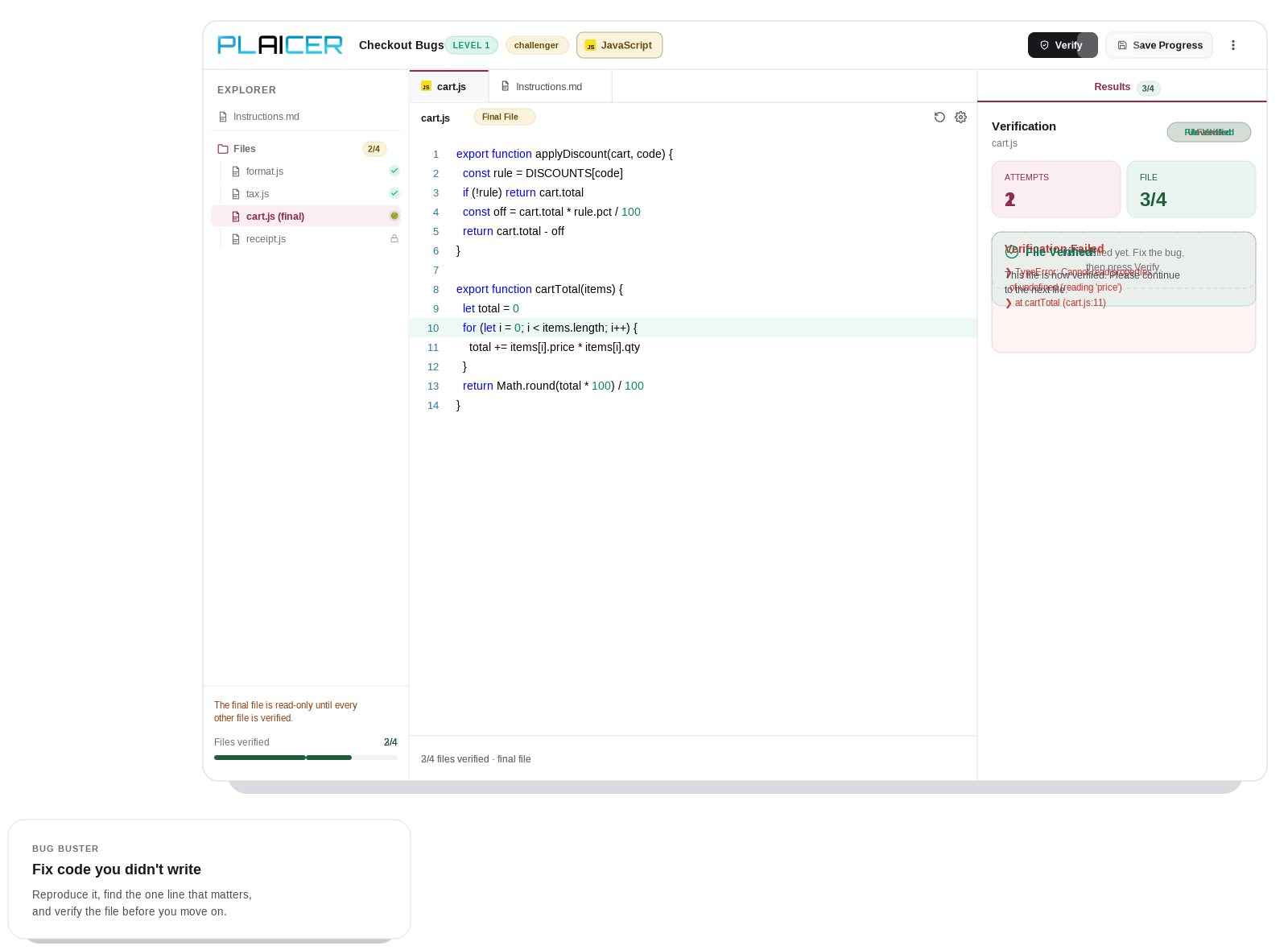
- Python Backend Tasks, write and repair backend code in Python to a written brief.
- C++ Backend Tasks, build a structure and its logic in C++ from a spec and an empty file.
- JavaScript Debugging Tasks, trace a wrong result back to the line that causes it.
- Code Judgement Tasks, choose between implementations of the same function and explain why.
What the 30/30 report card shows
A status for your submission
The status depends on how many of the behaviours checked failed, from Production behavior verified to Systemically unsafe for production.
Sample and hidden tests
Visible tests show their call and expected output. Hidden tests report only a pass or fail and a symptom line, and do not show their inputs.
Score, points and time
The report card shows your score, the behaviours passed, your points and your time, with a feedback line for each behaviour checked.
Two levels
Level 1 sets interview tasks. Level 2 sets daily tasks based on the work junior and mid-level engineers are expected to get right on the job.
Other ways people use Plaicer
Each page describes the products that matter most for one kind of reader and the interview each product prepares for.
Questions about Daily practice on Plaicer
Answers to common questions. For anything else, email the Plaicer team.
Email a questionWhen does a new task open?
A new task opens each day at 03.00 Malta time. Submissions for a day close at 01.00 the next morning. Between 01.00 and 03.00 the page shows Between days while the league tables are settled, and no task can be started.
What happens if I leave the task and come back?
Opening the day's task counts as your attempt. If you leave the task and come back, it does not open again, whether or not you submitted.
Which languages can I use?
Python, JavaScript, TypeScript, Java and Go, where the task supports them. Switching language replaces your code with the starter code for the new language, and the editor asks you to confirm first.
How does the streak work?
Your streak counts the consecutive days on which you submitted a daily task that passed at least one visible test. Missing a day ends it, and your best streak is kept.
Is 30/30 Daily Practice included in a credit pack?
No. 30/30 Daily Practice is part of the Training Ground, which is a monthly subscription you can cancel at any time. Access continues until the end of the period you have paid for.
Open 30/30 Daily Practice
Choose your level and language, then submit once before the daily reset. The report card for your submission arrives the next day.