Plaicer for working engineers
Every stage of Technical Interview Practice is available on its own, so you can practise the stage your next interview includes. In System Design you get a prompt with constraints and a canvas, and the interviewer asks about scaling, failure modes and the trade-offs behind each component you placed.
Stages cost 1 or 2 credits, and credit packs are one-time payments that never renew. Building with AI adds rounds on building a feature with an AI assistant and on designing an AI-assisted workflow for a business brief.
- System Design
- Code Review
- Building with AI
- Data Structures and Algorithms Screening Practice
Stages you can practise one at a time
Each card starts with what you face in a real interview, then what you can practise on Plaicer for it.
What happens on screen
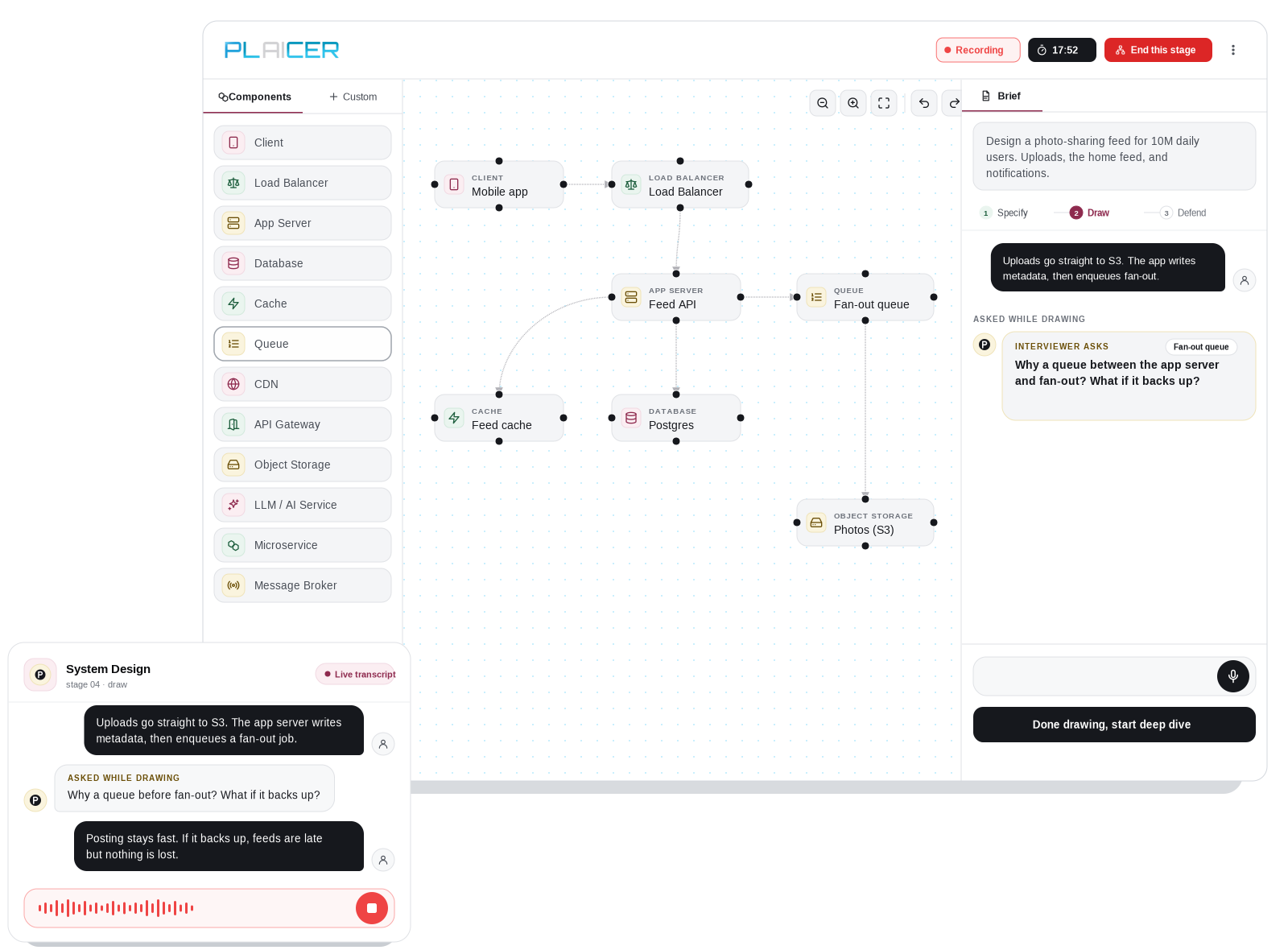
How System Design works
A system design interview gives you a problem with constraints and asks you to design a system and defend it. Here you get a design prompt and a canvas. You clarify the requirements first, then draw the system while explaining each choice to the interviewer.
Once the design is drawn, the interviewer asks about scaling, failure modes, bottlenecks and the trade-offs behind each component you placed.
- Ask about scale, reads and limits before you draw.
- Draw the system on the canvas and explain each part.
- Explain data flow, scaling and failure modes.
- Answer the interviewer's questions on your trade-offs.
How AI Workflow Design works
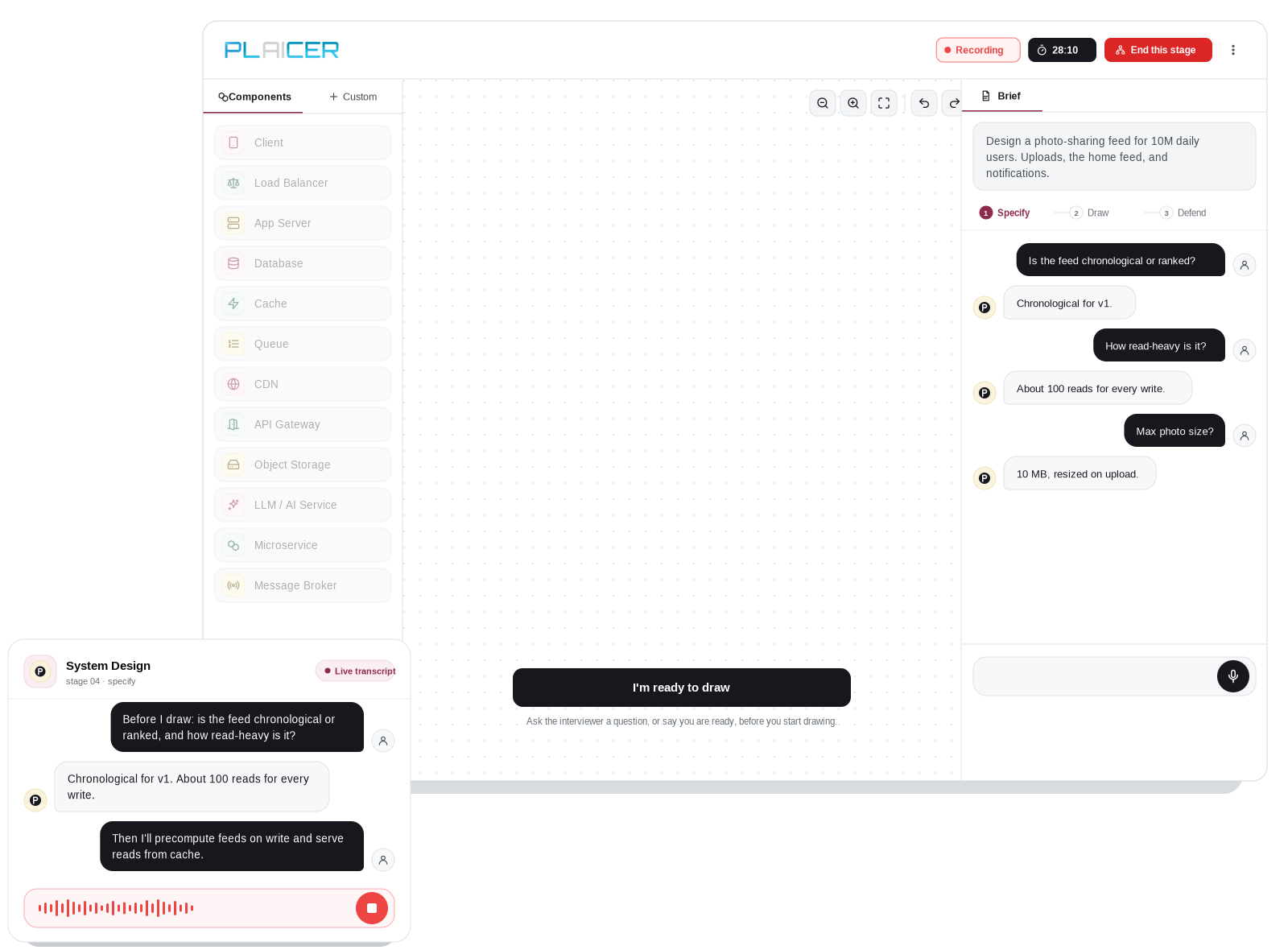
You get a business brief and a canvas. Ask the interviewer for the facts you need and what the brief means, then design the workflow step by step and explain it as you go. You decide which steps AI handles, which stay with people and how the process is checked.
When the design is finished, the interviewer asks what happens when a step fails, how you would roll it out alongside the existing process and where the risks are. You need a computer for this round.
- Read the brief and ask the interviewer your questions.
- Place the workflow steps on the canvas and connect them.
- Explain the design to the interviewer as you build it.
- Answer questions on reliability, safety and rollout.
How Code Review works
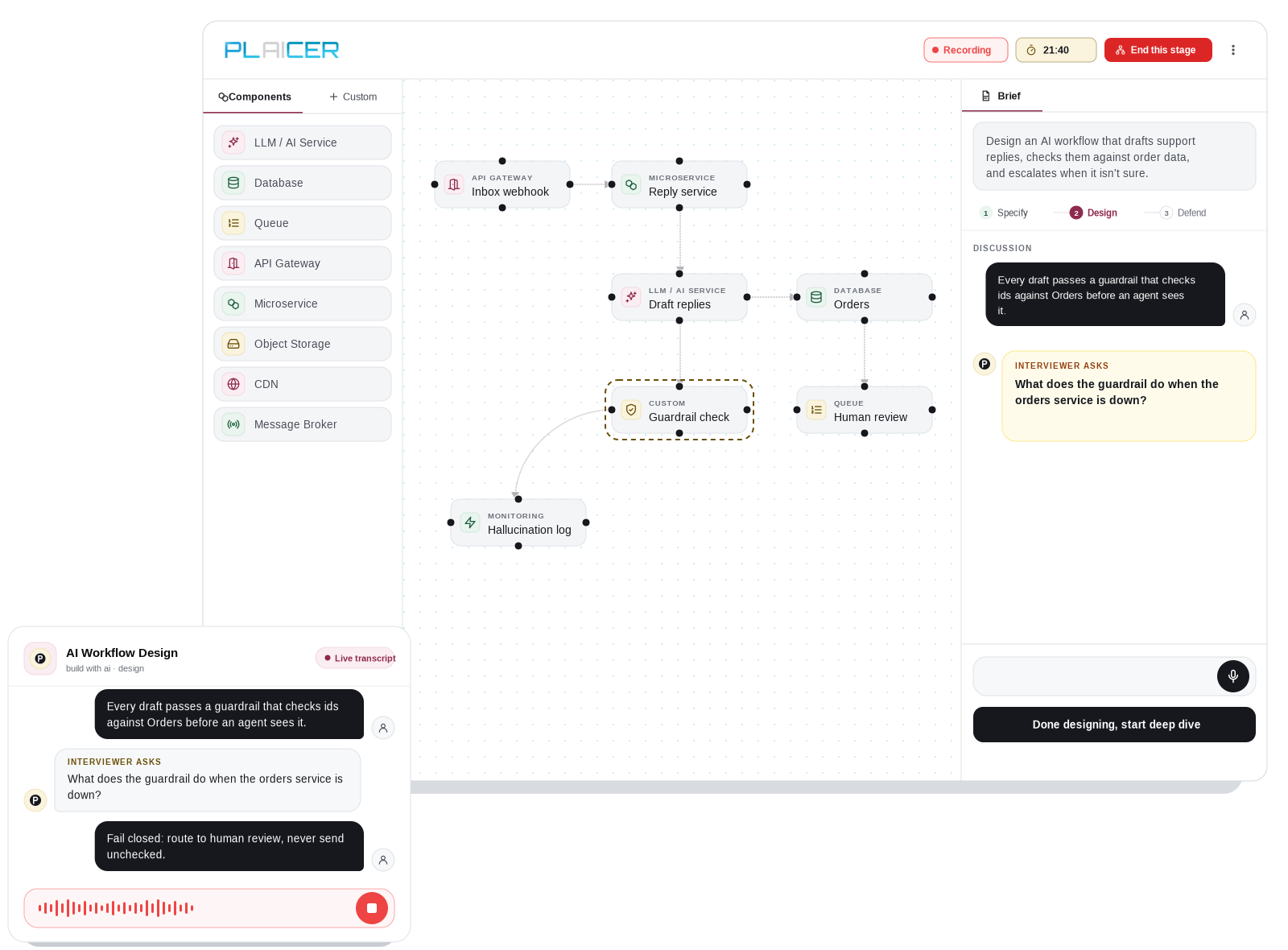
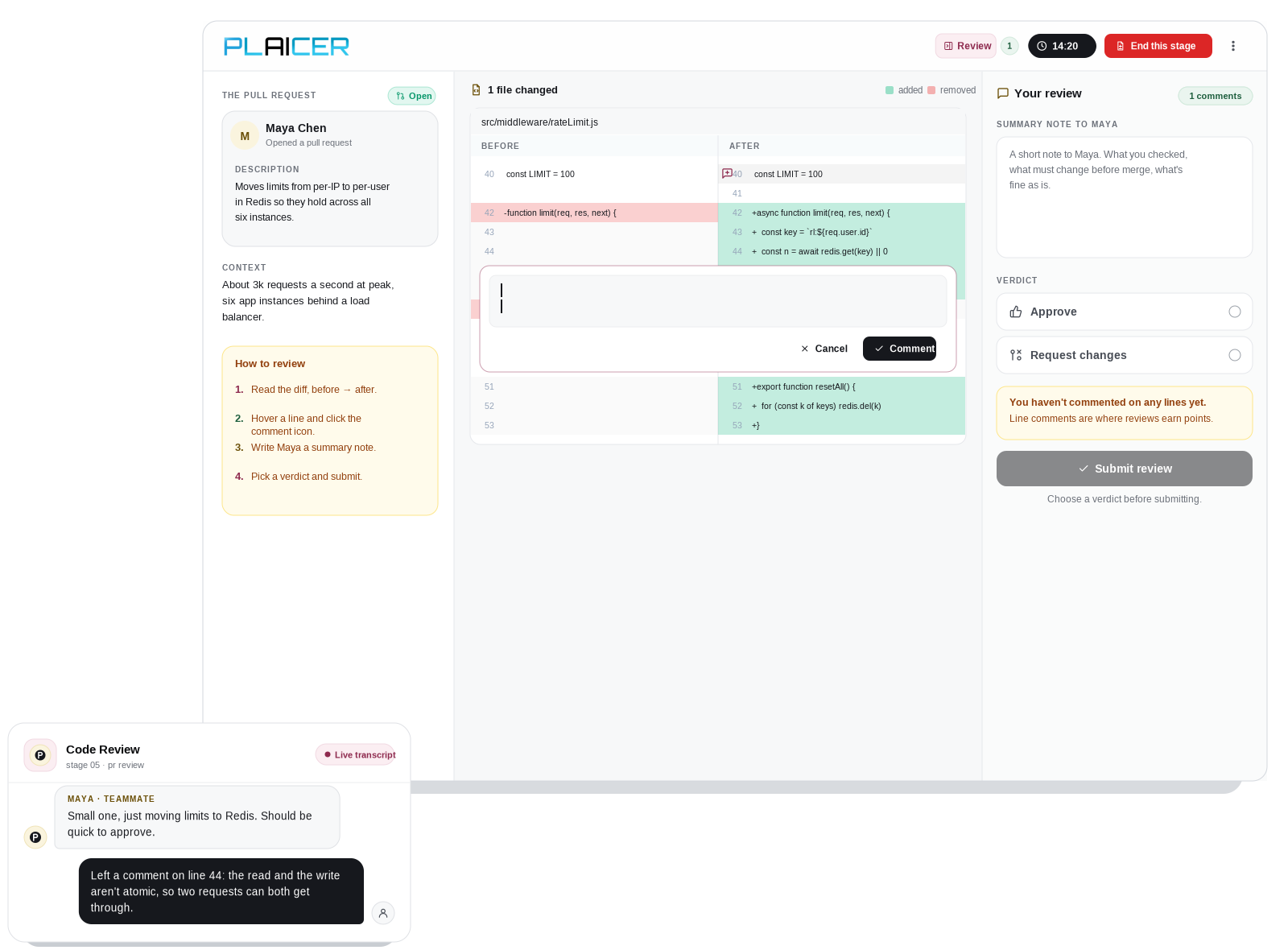
Some companies ask you to review a pull request to see what you find and how you write feedback. Here a teammate's pull request is assigned to you. You read the diff, comment on specific lines and approve it or request changes.
You are scored on the problems you find, from bugs to performance risks, and on how you word your comments. After you submit, the teammate asks follow-up questions about your review.
- Read the full diff before you comment.
- Leave comments on the lines that need them.
- Separate blocking issues from minor points.
- Approve or request changes and explain why.
What each stage and round costs
Choose one stage or several and check the credit total before you start.
- Interview Q&ATechnical Interview Practice1
- Project Deep DiveTechnical Interview Practice1
- Code ReviewTechnical Interview Practice1
- Live CodingTechnical Interview Practice2
- System DesignTechnical Interview Practice2
- Screening round, any formatData Structures and Algorithms Screening Practice2
- AI Knowledge Q&ABuilding with AI1
- AI Feature BuildBuilding with AI2
- AI Workflow DesignBuilding with AI2
Once you enter a stage, its credits are spent. Credits pool across packs, and unused credits roll over if you buy another pack before your current one ends.
What the report shows for each stage
Each stage gets its own report. It gives an overall score, a score for each named dimension, the areas to work on, your strengths and what to practise next. If you practise more than one stage, a summary looks across the stages for gaps that keep coming up.
Skills scored in every stage
- Communication
- Question-asking
- Depth under probing
Other ways people use Plaicer
Each page describes the products that matter most for one kind of reader and the interview each product prepares for.
Questions about Plaicer for working engineers
Answers to common questions. For anything else, email the Plaicer team.
Email a questionCan I practise System Design on its own?
Yes. Every stage is available on its own. Choose System Design, Code Review or any other stage, and each stage you complete gets its own report.
What does each stage cost?
Interview Q&A, Project Deep Dive and Code Review cost 1 credit. Live Coding, System Design and a data structures and algorithms screening round cost 2. In Building with AI, AI Knowledge Q&A costs 1 credit, and AI Feature Build and AI Workflow Design cost 2 each. Once you enter a stage, its credits are spent.
Do credits expire?
Credit packs are one-time payments and never renew. Unused credits expire with their pack unless you buy another pack before it ends, in which case they roll over. Credits from the 2-credit pack do not expire and are spent after any expiring credits.
Does Building with AI change my Technical Interview Practice score?
No. Building with AI keeps its own history and does not change your Technical Interview Practice progress score.
What happens if I stop part way through several rounds?
Rounds you complete keep their reports if you stop early.
Start Technical Interview Practice
Choose your role, your focus and the stages you want to practise. Each stage you complete gets its own report.