Plaicer for career switchers
Technical interviews test the work of the role. You fix broken code against a test suite, review a teammate's pull request and explain a project you built while the interviewer asks why you made each decision.
Plaicer lets you practise these stages with an AI interviewer that follows up on what you say and write. Training Ground tasks let you practise the code itself without the interviewer and without the microphone.
- Live Coding
- Code Review
- Python Backend Tasks
- Building with AI
Interview tasks that test the work of the role
Each card starts with what you face in a real interview, then what you can practise on Plaicer for it.
What happens on screen
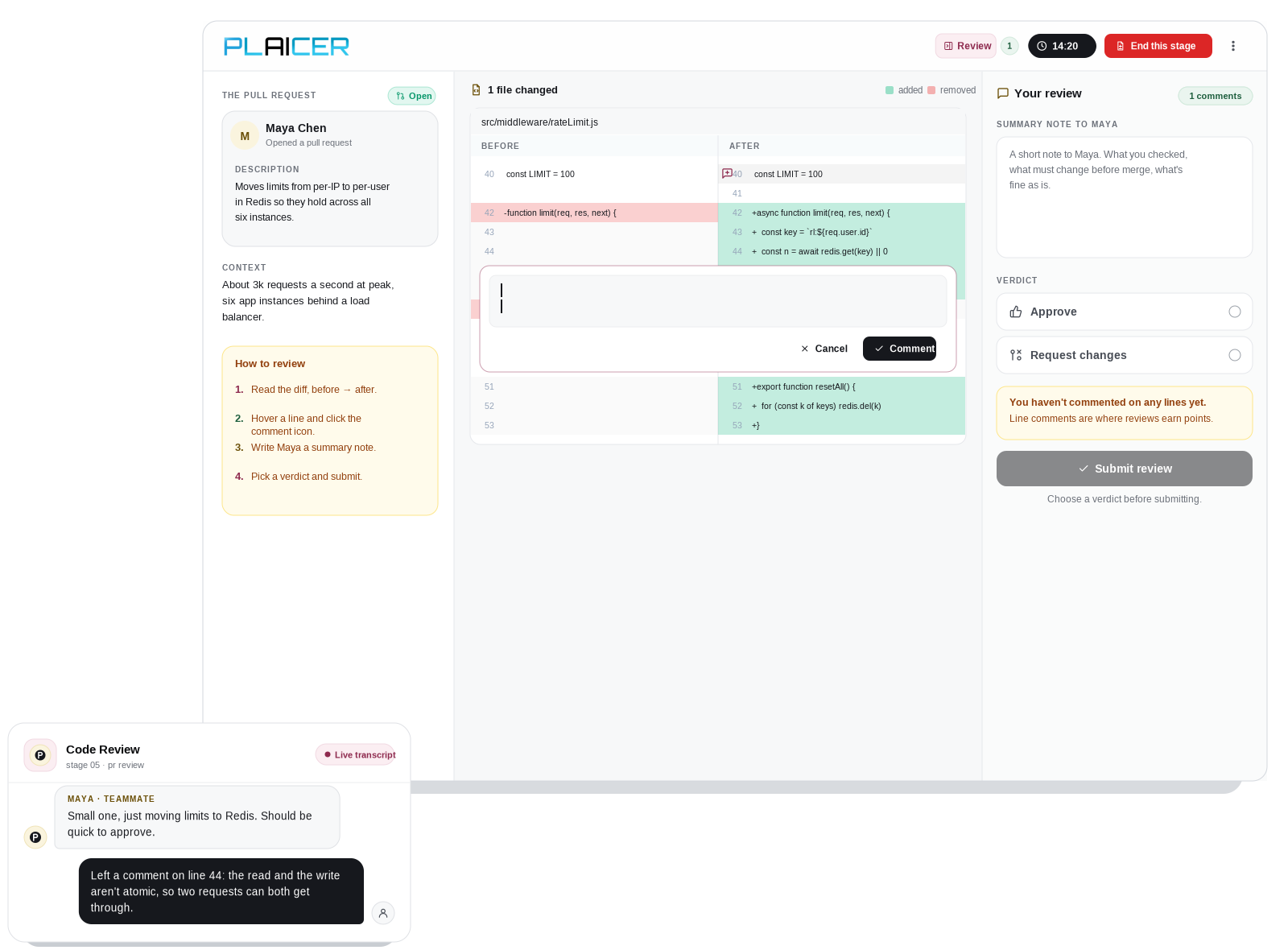
How Code Review works
Some companies ask you to review a pull request to see what you find and how you write feedback. Here a teammate's pull request is assigned to you. You read the diff, comment on specific lines and approve it or request changes.
You are scored on the problems you find, from bugs to performance risks, and on how you word your comments. After you submit, the teammate asks follow-up questions about your review.
- Read the full diff before you comment.
- Leave comments on the lines that need them.
- Separate blocking issues from minor points.
- Approve or request changes and explain why.
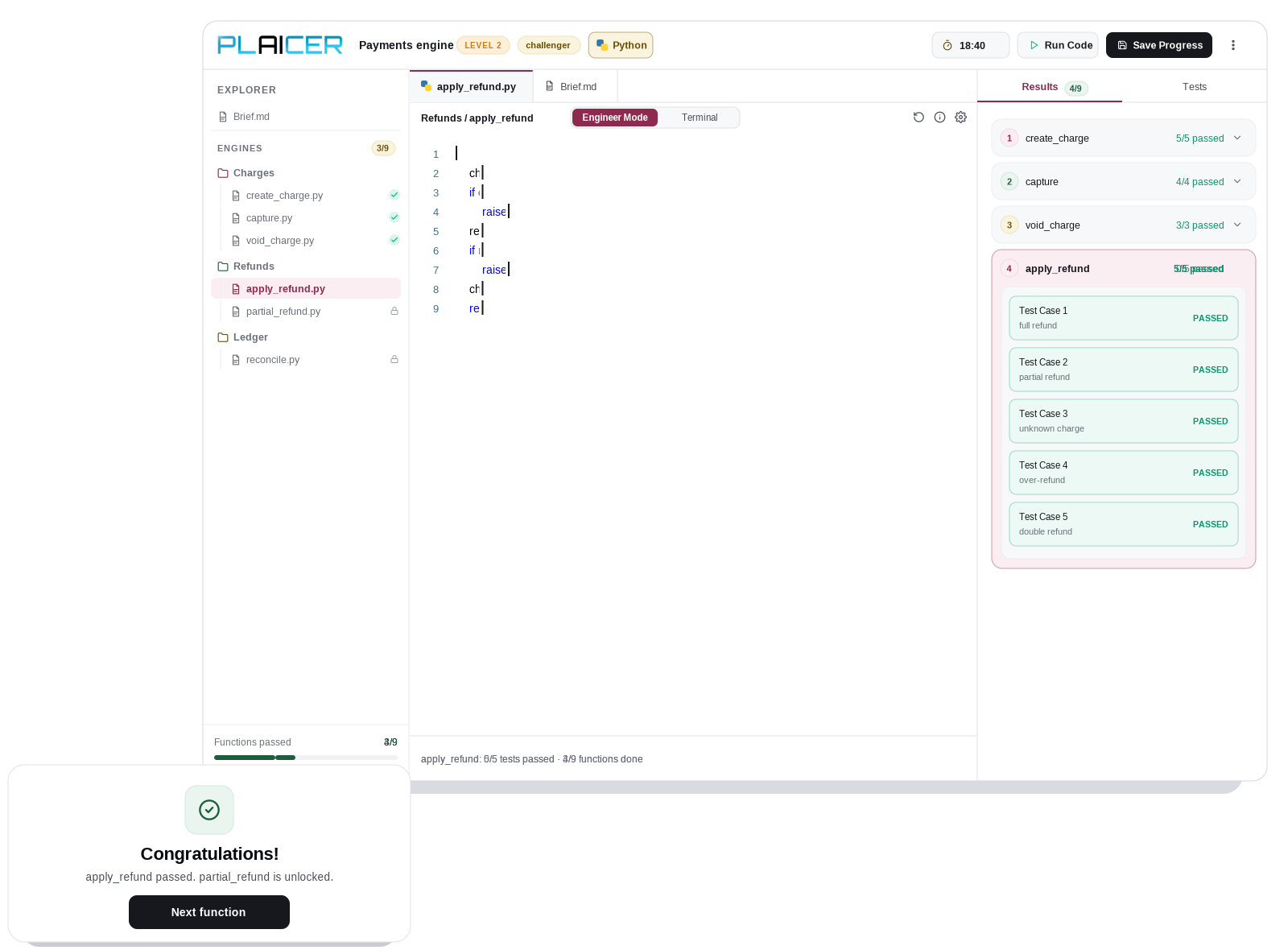
The three levels of Python Backend Tasks
Python Backend Tasks have you build and repair backend code to a written brief. Some functions you write from scratch and some you inherit with a bug. Each one has to return exactly what the brief describes.
C++ Backend Tasks follow the same idea in C++. You read a spec and build the structure and its logic from an empty file, and larger tests measure the cost of each design decision.
- Level 1, correct functions from a brief with clean inputs.
- Level 2, inputs in the wrong shape and dependent systems that fail.
- Level 3, functions combined into multi-step workflows.
How AI Feature Build works
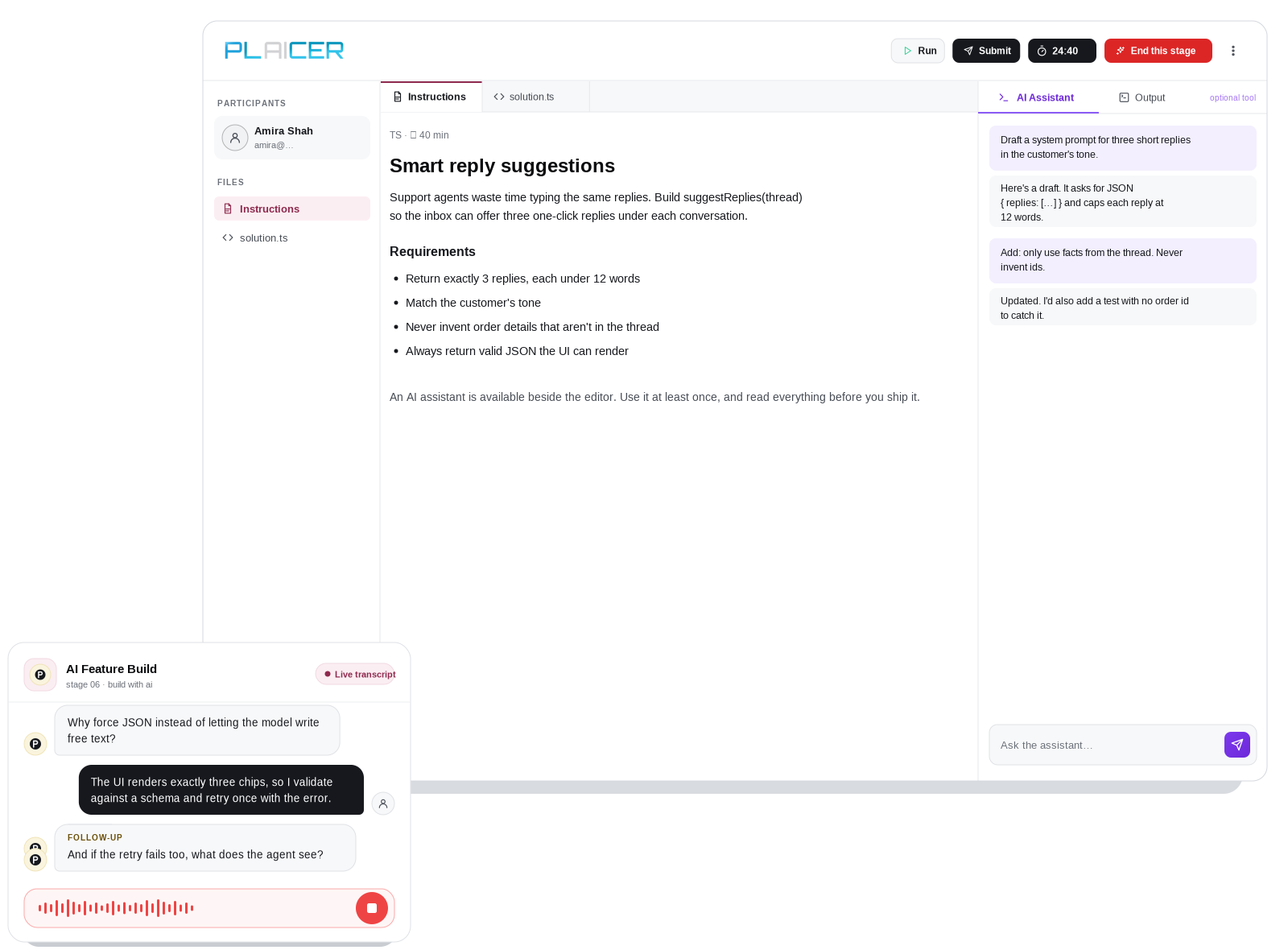
Some coding interviews give you an AI assistant and assess how you use it. Here you get a short feature brief, starter code, a test suite and an AI assistant you can prompt. Every decision about what goes into the final code is yours.
You need at least one exchange with the assistant before you can submit, because reviewing its code is part of what is assessed. The number of prompts you send is not scored.
- Read the feature brief, the starter code and the tests.
- Prompt the assistant for what you need.
- Check its code, fix what is wrong and run the tests.
- Answer the interviewer's questions about your decisions.
How explaining your reasoning is assessed
Reasoning counts alongside the tests
In Live Coding the interviewer scores your reasoning as well as the tests, so correct code with no explanation scores lower than code with clear reasoning behind it.
Skills scored in every stage
Communication, question-asking and depth under probing are scored in every stage of Technical Interview Practice.
Clarifying questions are part of the stage
You can ask clarifying questions at any point in Live Coding. In System Design you ask about scale, reads and limits before you draw.
Spoken answers are kept as text
Your speech is transcribed by your browser's built-in speech service. Plaicer stores the text transcript and does not store audio.
How each score is described
Every stage is scored on named dimensions against published criteria. Every score uses one of four words.
Developing
There is little evidence of the skill so far. The report names the dimension that cost you most, so you know where to practise.
Emerging
The skill shows but is incomplete. Answers and code work in part, and the report shows which parts to close first.
Competent
The skill does the job with gaps you can name. The report shows what separates this score from Strong.
Strong
Answers are specific, correct and well reasoned against the published criteria, in the technical content and in how you explain it.
Other ways people use Plaicer
Each page describes the products that matter most for one kind of reader and the interview each product prepares for.
Questions about Plaicer for career switchers
Answers to common questions. For anything else, email the Plaicer team.
Email a questionDo I need to speak during the stages?
Most stages ask you to explain your reasoning to the interviewer by voice, so you need a working microphone. Training Ground tasks have no interviewer and no microphone.
How is my reasoning scored in Live Coding?
The interviewer scores your reasoning as well as the tests, so correct code with no explanation scores lower than code with clear reasoning behind it. After you submit, the interviewer asks about your approach.
Which languages do the Training Ground tasks use?
Python Backend Tasks use Python, C++ Backend Tasks use C++ and JavaScript Debugging Tasks use JavaScript. Code Judgement Tasks have you compare implementations of the same function.
Do I have to use the AI assistant in AI Feature Build?
Yes. You need at least one exchange with the assistant before you can submit, because reviewing its code is part of what is assessed. The number of prompts you send is not scored.
Is my voice recorded?
Your speech is transcribed by your browser's built-in speech service. Plaicer stores the text transcript and does not store audio or video.
Start Technical Interview Practice
Choose your role, your focus and the stages you want to practise. Each stage you complete gets its own report.